
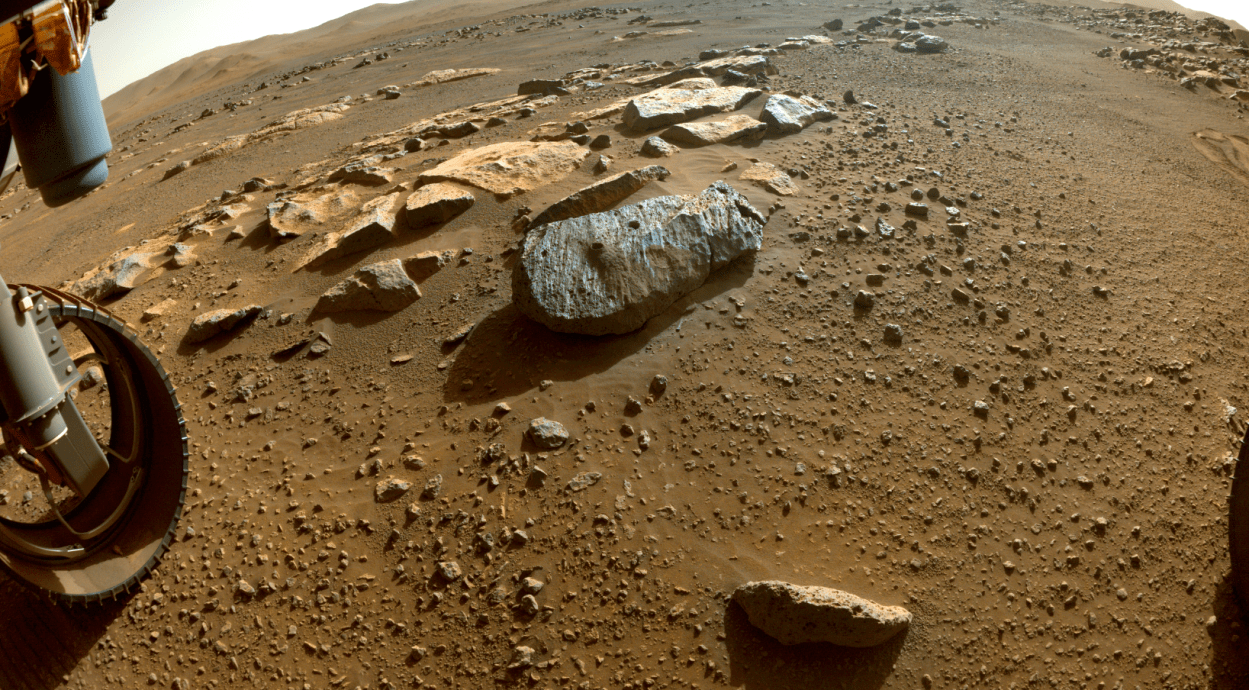
Like many others, I suspected there was water on Mars and created a graphic illustration about it in 2018. Today, I learned that David Szondy published an article on New Atlas’ website about water in the subsurface layers of Mars. The article reported findings of a study that analzed data from Insight Lander, “the first outer space robotic explorer to study in depth the inner space of Mars: its crust, mantle, and core.”

“There’s a whole ocean’s worth of water locked in that rock, but the problem is that it’s inaccessible. According to the team, the layer is 11.5 to 20 km (7 to 13 miles) beneath the surface, which means reaching that giant aquifer, much less tapping it, would be a major engineering challenge on Earth, to say the very least, let alone in the harsh environment of Mars.”
The authors of the study, Liquid water in the Martian mid-crust, are Vashan Wright, Matthias Mozfeld, and Michael Manga. It was published August 12, 2024 on PNAS. A summary of the study is below.

Study Summary of Liquid Water on Mars
This study investigated the possibility of liquid water existing in the Martian crust using data collected by the InSight lander. Here’s a breakdown of the key points:
Background:
- Mars likely had rivers, lakes, oceans, and aquifers billions of years ago.
- It’s unclear where this water went after Mars lost most of its atmosphere.
New Evidence:
- Seismic data from InSight suggests the presence of liquid water in the mid-crust (between 11.5 and 20 km deep).
- Rock physics models were used to analyze the data and support the hypothesis of water-filled fractures.
Key Findings:
- A mid-crust composed of igneous rock with fractures filled with liquid water best explains the observed seismic velocities and density.
- The amount of water in the crust could be substantial, potentially exceeding the volume of ancient Martian oceans.
Implications:
- This finding challenges the notion that Mars lost most of its water to space.
- Liquid water in the crust could influence the Martian hydrological cycle.
Future Work:
- More data and constraints on Martian crust composition are needed for a more definitive conclusion.
- Further research is necessary to understand the permeability and temperature conditions that allow water movement within the crust.
Overall, this study presents compelling evidence for the existence of liquid water in the Martian mid-crust, raising exciting questions about the history and potential habitability of Mars.
 Kaye James